 Welcome back, class.
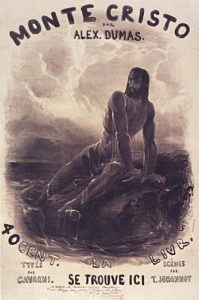
Reading The Count of Monte Cristo was a journey of several months, like my experience with Ulysses and The Divine Comedy. But length is no indicator of difficulty—while it was never “easy,” it was consistently accessible, unlike Ulysses and The Divine Comedy. There were things that I wasn’t expecting, and even things I didn’t like, but in general The Count of Monte Cristo was a classic that I’m proud to have read. I could read another Alexandre Dumas novel without hesitation (I’m looking at you, The Three Musketeers).
It starts with Edmond Dantès, who is unjustly imprisoned by men jealous of his success. In prison, an older man befriends him, teaches him the full spectrum of human knowledge, and reveals the hiding place of his inherited treasure. Dantès escapes and finds the treasure, buried on the island of Monte Cristo; using the money, he develops the disguise of the Count of Monte Cristo and uses it to exact revenge on those who destroyed his life.
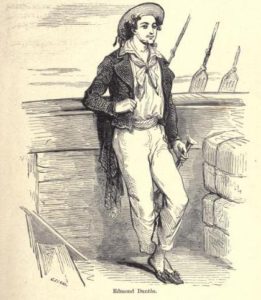
Illustration of Edmond Dantès
That’s only the first couple hundred pages—about one-fifth of the story. The rest, while at times not nearly as exciting, is the painstakingly long course of events allowing the count to destroy his enemies. It’s not enough for him to take their lives or torture them; he concocts the exact punishment necessary for each enemy, without directly attacking them. There are bumps along the way, each one making it that much more exciting to see him successful, and so the novel spans decades to reach an almost perfect ending—but I won’t spoil it.
The strengths of The Count of Monte Cristo are not in great literary merit or symbolism, like most of the other books on the list. This is a plot- and character-driven story that’s meant to be entertaining, plain and simple. I spent most of my time reading it wondering what Dantès would do next, and to whom; I sympathized with him as much as I feared him. Dantès transforms from a kind soul to a vengeful spirit, and he is as intimidating as he is heroic—the terrible things he commits himself to doing are matched only by the commitment with which he does them. He becomes a legend, and that legend makes The Count of Monte Cristo worth reading.
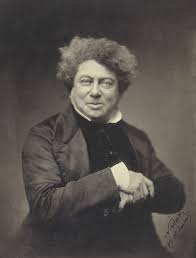
Author Alexandre Dumas
Beyond that, it’s worth noting that Alexandre Dumas knows exactly how to delay the reader’s satisfaction. Some chapters begin with characters we’ve never met before, and while we sift through who they are and why we aren’t focusing on Dantès, we’ll suddenly realize that one of these characters is Dantès in disguise, subtly manipulating the scene to his own ends. Other times we focus on interesting subplots dragged out for dozens of chapters, only to see Dantès enact his revenge on these extra characters, years of his work successful in an instant. The novel is so long because Dumas teases it out for, if nothing else, dramatic effect. Even when things are confusing, they’re fresh and exciting too, because Dumas tells a good story in the best way.
Next up, I’ve been reading the similarly long novel Anna Karenina, also for several months. I don’t know how I gained the ability to read multiple novels at once, which I know baffles some people, but I absolutely love it. I couldn’t have enjoyed reading The Count of Monte Cristo for so long if I didn’t diversify things with other novels. Surviving college sometimes meant juggling four different novels from four different literature classes—it brings a smile to my face just thinking about it. I just love reading so much.
I’ll leave you with that thought.
Prof. Jeffrey



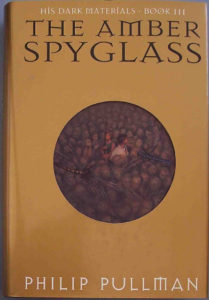 But for Pullman, it wasn’t enough to point out the corruption of religious institutions—his novels attempt to reveal corruption in the existence of God. He writes about the ongoing battle of humanity, between those who humbly submit to a greater power and those who seek wisdom and refute oppression. His novels point out the inherent immorality of a Kingdom of Heaven, like the immorality of any dictatorship in the modern age. The overarching plot of the trilogy goes so far as to use Christian theology (and mythology) to dismantle the Christian story of God—portraying God as the villain of humanity’s ongoing battle.


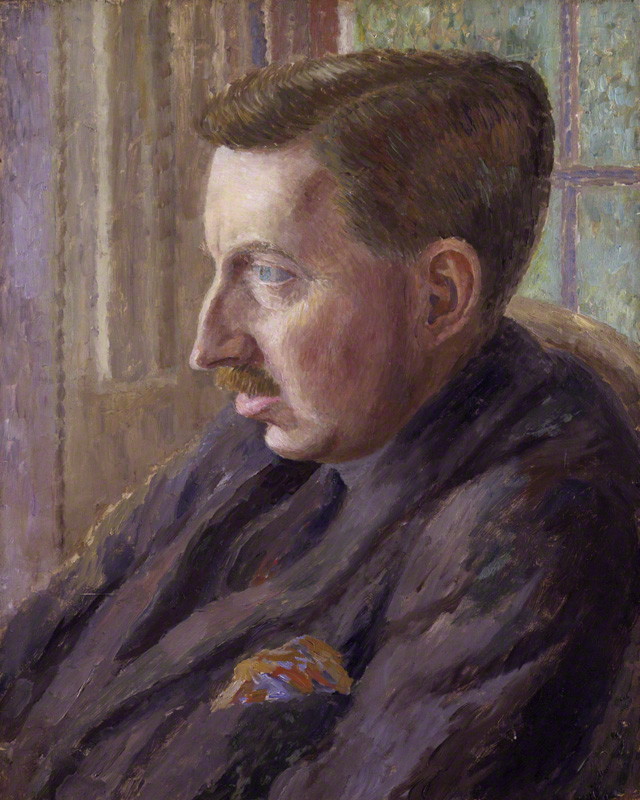
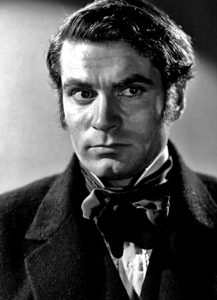
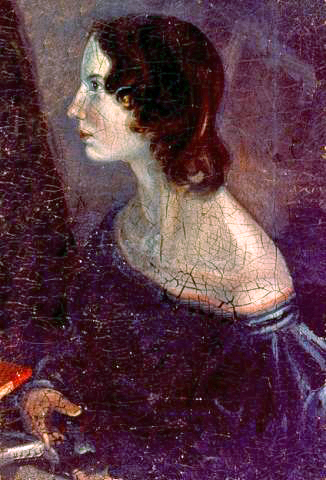
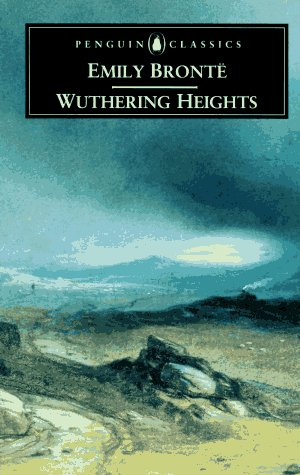 It’s easy to see the similarities between Charlotte Brontë’s Jane Eyre and her sister Emily Brontë’s Wuthering Heights. In both stories, the swampy moors of the English countryside set an atmosphere of oppressive weariness and longing. The romances tracked in both novels have drama seeping through the pages—lies, betrayal, terrible passion, and a man too mysterious to ever fully trust.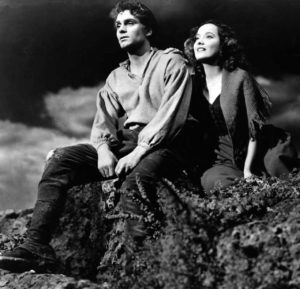

 The society of Brave New World runs on a set of rules that everyone happily follows; for instance, solitary actions are as prohibited as possible, and in sexual terms, everyone belongs to everyone else. Extreme emotions have been all but eradicated with removal of the family unit, genetic modification, psychological conditioning, and a drug called soma. Without extreme emotions—passion, rage, fear, jealousy, misery—all that’s left is a mellow contentment. Between universal happiness and ideals like truth, beauty, or knowledge, the populace has overwhelmingly chosen happiness.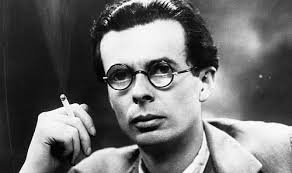
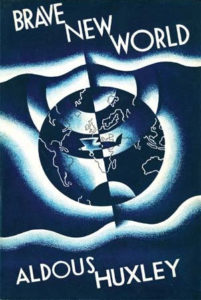 1984 is about a regime holding power and using ideology, propaganda, and torture to subdue threats . . . humanity’s enemy is more powerful than ever, but it’s the same enemy: an upper class with all the power. Brave New World might even be scarier, because there is no enemy. Humanity simply gave up, surrendered to happiness. All the things we like to think make humanity good—art, morality, intelligence, curiosity, passion . . . all replaced by peace. A numbing, terrifying global peace.
 It’s a basic concept of a story: a group of boys is involved in a plane crash on a deserted island, and there are no grown-ups to lead them. They start out well enough, organizing themselves, electing a leader, establishing a hunting team—but a childish tension erodes it all. To top it off, they start to imagine a beast somewhere on the island, that it may be hunting them and planning to kill them all. Their fear and resentment against each other soon become hatred, anger, revenge, and eventually murder.
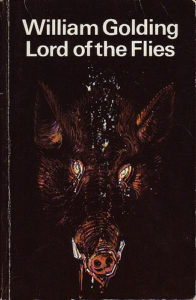 There is one other boy who deserves mentioning: Simon, the quiet boy younger than Jack, Ralph, and Piggy, serving as a kind of bridge between the “biguns” and the “littluns.” He’s smart—not in the same way as Piggy, who is rational and critical, but in a more creative and reflective way. Simon doesn’t say or do much, but he is the only boy on the island who sees and understands who (or what) the Lord of the Flies really is.
 Good morning, class.

Recent Comments