 Hello again, class.
World War I and World War II are often lumped together as a collective global stain of history. They are so linked that WWII is usually seen as an extension of WWI, and it’s hard to talk about one without the other. It’s easy to forget that at the time, WWI was its own devastating conflict, worse than anything that had come before it and unimaginably tragic on its own.
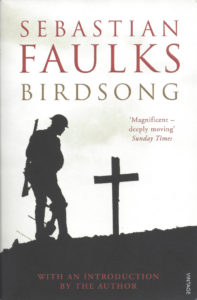
That seems to be the driving motive behind author Sebastian Faulks’ novel Birdsong. In lumping together both World Wars, the identity of the first Great War gets lost in the past—Birdsong is about bringing that past to the forefront, lending focus to the social and cultural atmosphere at the time of WWI. The story is in its own way about uncovering history, using it to guide our present and plan our future while appreciating it for what it is, regardless of what happens next.
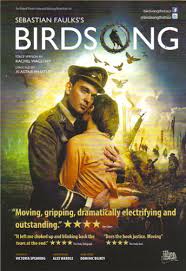
Poster for the stage adaptation of Birdsong (2010)
Faulks wouldn’t be able to accomplish this without a supportive story, and good characters to populate it. It’s safe to say that Stephen Wraysford is Birdsong‘s main character—he is a man with a complicated upbringing coupled with a melodramatic love affair in his early 20s, who is thrust into the Great War. His relationships with other men in the war help to humanize the conflict, though with all the violence he sees, he is always questioning humanity and its destiny. He seems fairly determined to hide his past, though he isn’t ashamed of it, and his love affair plays an important role in his future.
Fast-forward to the 1970s, where we meet a woman who is presumably his granddaughter—Elizabeth Benson, who shares some of the responsibility as main character. This 38-year old woman, having an affair of her own, is contemplating her place in life and decides to unearth her ancestral history. The novel jumps back and forth between Stephen’s perspective and Elizabeth’s, merging both points of view to appropriately assess the events of the war.

Author Sebastian Faulks
Birdsong is historical fiction—not a dramatization of real events. A based-on-a-true-story approach might have worked just as well for the sake of realism, but Faulks isn’t interested in detailing who did what where. He created fictional characters to fill them with the spirit of the people involved. Birdsong is a human drama, not a war epic or a nonfiction account—those things would be about the war itself, which is just another conflict in our history. Birdsong instead tells a story about individuals, who bear the weight of a larger catastrophe and question their place in it all.
If it were boiled down to one thing, Birdsong is a story about the best and worst of human nature. Stephen constantly asks himself how far the people in this war are willing to go, and nothing he sees lets him rest easy. But humanity has its moments of redemption in the way individuals treat each other: the way soldiers treat fellow soldiers, the way Stephen treats those he loves, and the way Elizabeth is able to find love amidst the war of her past. Humanity can be a cannibalistic hunger, a vain and selfish ambition that threatens its own existence, but it can also be warm and compassionate, full of love and hope. Birdsong makes the list for portraying humanity at its ugliest and at its most beautiful.
I liked reading Birdsong a lot, which has maybe contributed to my distaste for the next book on the list—a novel by Martin Amis called Money: A Suicide Note. I know why it made the list, but all the same I haven’t enjoyed it at all . . . but I’m getting ahead of myself. More on that next time.
Until then,
Prof. Jeffrey
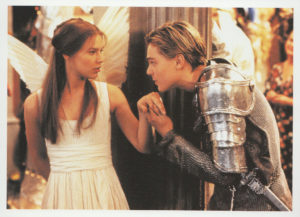
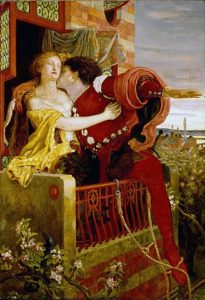 It’s a story old as time—two teenagers, Romeo Montague and Juliet Capulet, become instantly infatuated with each other at first sight, even though their families are involved in an ongoing feud. They decide to get married, and in a complicated plot to get their families to stop fighting, Romeo kills a man and is banished, Juliet pretends to die to get away from her family, Romeo thinks Juliet is really dead and kills himself, and Juliet kills herself shortly after. Tragedy abounds.
 I’ve made it clear that my favorite eras of literature are
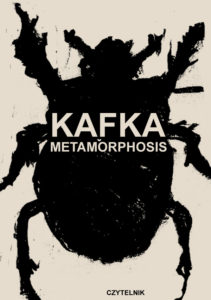
 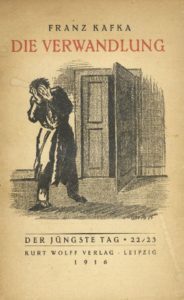 The story doesn’t waver from this approach. The Metamorphosis is the most absurd family drama ever written, about how a family deals with the weight of their dutiful Gregor’s untimely transformation. Any truly fantasy narrative would capitalize on the strangeness of the fantasy, but instead, Kafka makes his story about the regular struggles of everyday life—just with an added wrinkle. Few novels can pull this off well, so for that alone, The Metamorphosis deserves to be on the list.

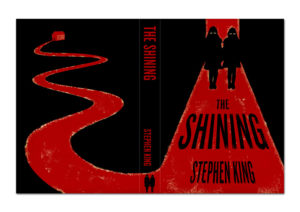 The story: a small, struggling family watches over the Overlook Hotel through the winter, as supernatural forces try to tear them apart. The father’s alcoholism leaves him vulnerable to the violent spirits in the hotel, and he becomes monstrously abusive. His wife tries to protect their little boy, who just happens to have the ability to communicate with the spirits around them—an ability called shining.
Recent Comments